
How AI Is Reshaping the Way We Describe and Deliver Transformation
Written by Melanie Franklin
Introduction
The Change Capability Community December session explored an increasingly important shift in transformation practice: the impact of AI on how we write, structure and communicate change. Melanie Franklin shared a series of observations drawn from recent work, including a major programme in the Middle East, that highlighted how AI is forcing organisations to become far more precise and comprehensive in their change descriptions.
Your use of AI Tools
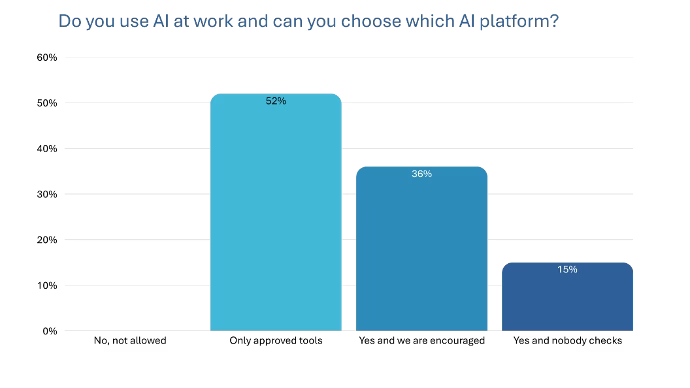
Before we started, we asked about your use of AI tools. It’s clear you are using AI, the tool is often dictated by your workplace but some still need the proof that it’s going to be useful.
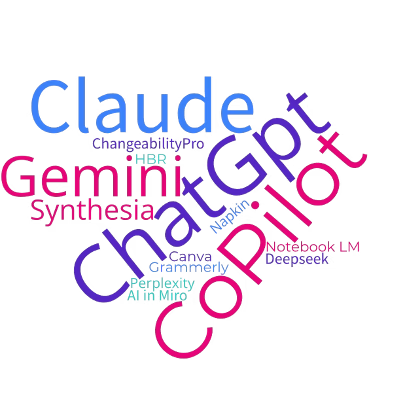
When we asked which tools you use you told us these are your preferred tools with some stating they used co-pilot for work and ChatGPT at home. We also heard that some of you prefer to use applications with AI included in the platform.
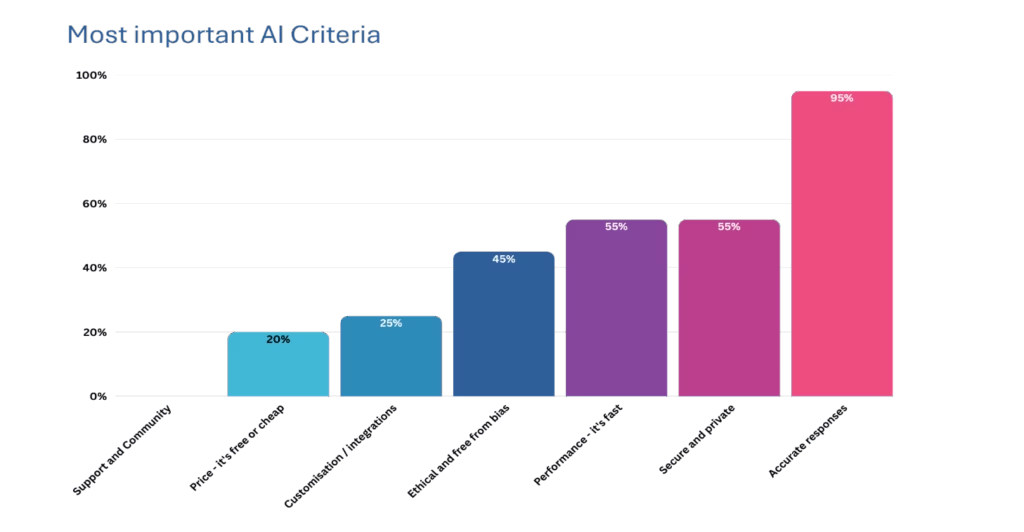
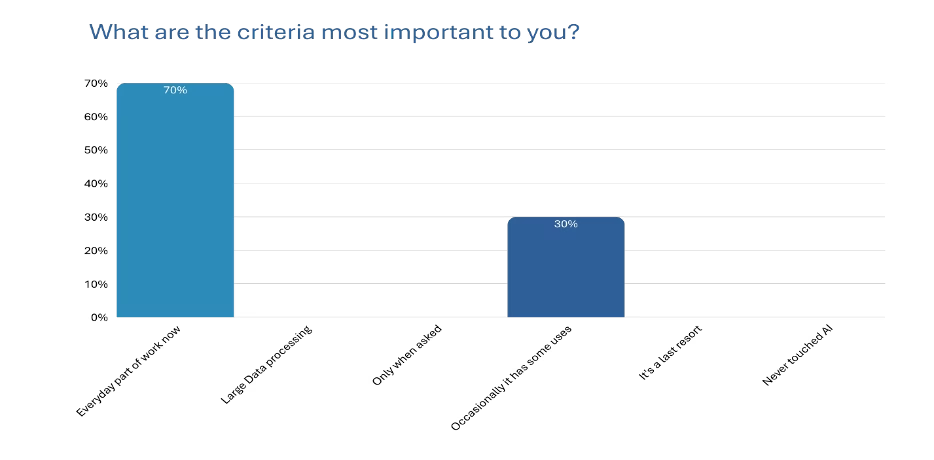
Top-Down Vision vs. Local Interpretation
We opened by describing a pattern many of us recognised. A transformation programme is launched strongly from the top:
- Strategy office sets out the ambition.
- The CEO communicates the future state at town halls.
- Divisional heads echo the message in their own meetings.
But after that initial cascade, momentum drops. Departments and teams are left to work out what this actually means for their day-to-day work. That gap between top-level intent and local understanding is not new — but AI tools are now making it visible much earlier.
In the organisation referenced, departmental and team leaders were already pasting the corporate vision into ChatGPT and asking, “What does this mean for my area?” The quality of the answer depended entirely on how clearly the programme had been described.
The Need for Much More Structured Information
One of Melanie’s strongest insights was that AI is teaching us to write differently:
- AI needs structure to reason effectively.
- Headings, explicit fields, and clearly defined categories improve clarity.
- Ambiguous writing produces ambiguous outputs.
She shared an example slide containing a large set of headings — objectives, outcomes, benefits, work types, staff impacts, customer impacts, supplier impacts, reputation, values, beliefs, behaviours, ethics, and priorities. This breadth reflects what AI needs if it is to give meaningful downstream answers.
Melanie admitted that she now catches herself writing for AI — deliberately adding headings, breaking up paragraphs, and removing vague language to ensure the information can be processed consistently.
The Power of Localisation — Now Accelerated by AI
We contrasted the current moment with an earlier experience at the European Medicines Agency. For years she carried a printed vision statement in her handbag and would place it in front of divisional heads asking, “What is your version of this?”
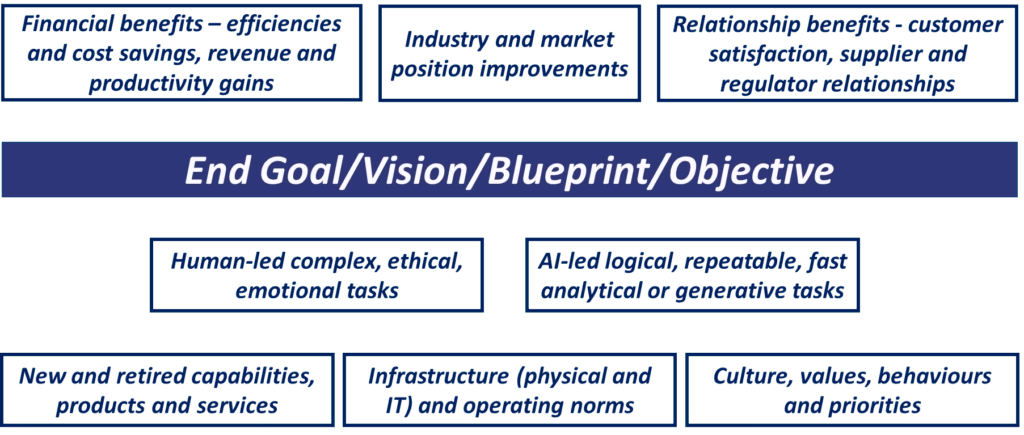
It empowered leaders because they translated the corporate future state into something meaningful locally.
Today, the same localisation happens — but teams are using AI to accelerate it. They know their context well and can combine it with the structured programme description to produce tailored, relevant interpretations.
This makes one thing clear: the burden is on the transformation team to write the programme in a way that AI can accurately interpret for every level of the organisation.
The Importance of Removing Ambiguity
We discussed how subjective or vague wording confuses both AI and humans. Melanie shared a recent debate with a senior leader who wanted the organisation to become “world-leading.” She pushed back: what does “world-leading” mean?
- Market share?
- Customer satisfaction?
- Innovation rate?
Unless these phrases are unpacked, AI cannot infer the intended meaning — it will generate its own interpretation.
The same applies to boundaries. We gave practical examples:
- A power-station programme including 68 facilities but excluding nuclear sites.
- An automotive initiative including electric vehicles but excluding all petrol and diesel engines.
- When boundaries are not explicit, AI fills gaps with assumptions — sometimes nonsensical ones.
State the Obvious — Because AI Does Not Know Context
One of the morning’s anecdotes illustrated this perfectly. Someone asked AI, “What’s the alternative to this change?”
AI responded, but the answer was meaningless because the change itself had never been defined.
Humans often rely on shared organisational context. AI does not have that context unless it is provided.
The lesson: never assume AI knows what you mean — tell it everything upfront.
Human Tasks vs. Machine Tasks
The session also explored how AI is changing role design.
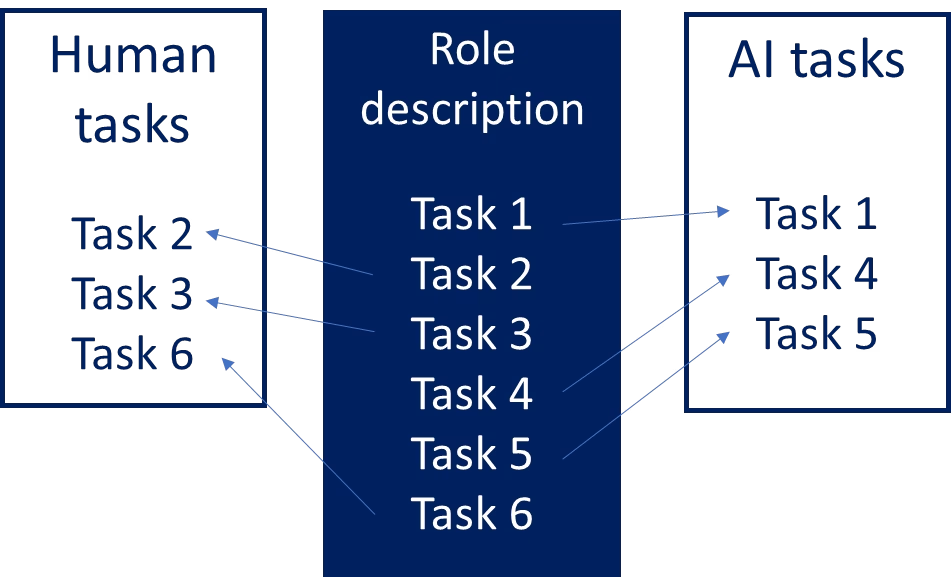
Melanie described emerging work with HR directors who are starting to separate responsibilities into:
Human tasks
- Building relationships
- Exercising creativity
- Applying emotional intelligence
- Making ethical judgements
Machine tasks
- Processing large volumes of data
- Performing tasks requiring consistency
- Operating at high speed
- Handling unambiguous information
In some organisations, role maps already include “AI equivalents” — for example, the tasks that an “AI version of the CFO” could handle, leaving the human CFO to focus on judgement, relationships and decision-making.
AI-Compatible Change Descriptions — A New Quality Standard
A major conclusion from the session was that AI is creating a new standard for what a high-quality change description looks like.
It must be:
- Structured (headings, clear sections, consistent formatting)
- Unambiguous (no subjective labels without definition)
- Explicitly bounded (what’s in scope and what isn’t)
- Complete (no missing pieces AI could incorrectly infer)
- Context-rich (so teams can use AI to localise meaning)
Organisations that adopt this approach early will see fewer misunderstandings, better local engagement, and far more accurate AI-generated interpretations of their change programmes.