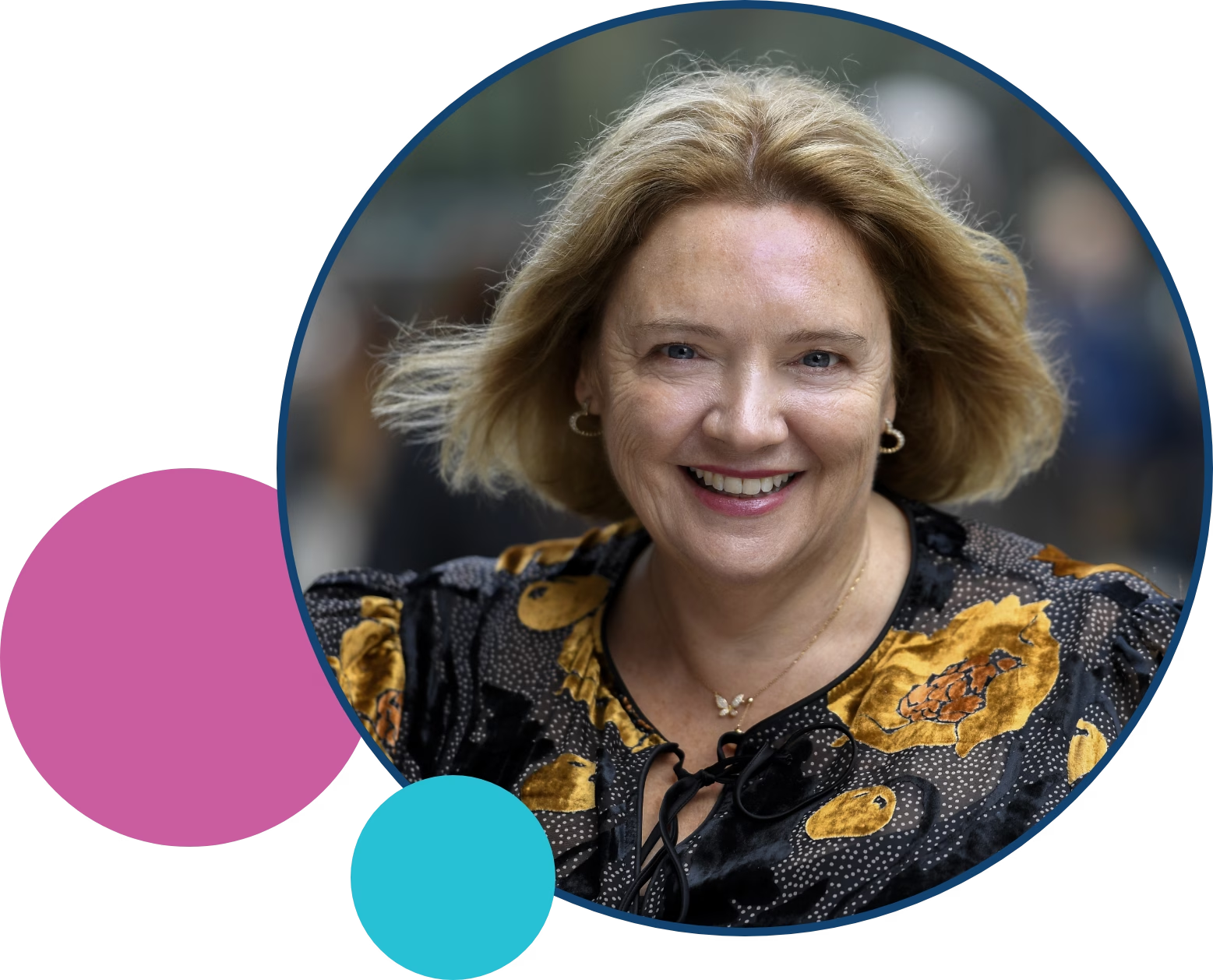
How I Became a Change Manager: Melanie Franklin’s Journey Through Projects, People and Purpose
Written by Melanie Franklin
This blog describes my journey into change management. I have written this to reassure those who think that “they have missed their chance” to work in change roles because they are not already a change manager. I hope I show that change, with its wide variety of skills is a role that we can take up at any time in our careers.
Where My Change Management Story Begins
I became a change manager partly in response to circumstances and partly through my own deliberate actions. My story begins when I took my first role as a business analyst and absolutely loved the opportunity to look at how the organisation I worked for—a bank—actually worked underneath the surface.
I had a job where I had to define all the processes for international trade payments. It gave me a fantastic structure I still use today: recognising there are five elements to any process. There’s the actual things we do sitting there in the middle. There are the things we use to do those tasks—the inputs that come from external suppliers, internal colleagues, information from different systems, actions that customers take. By fulfilling our process, we create something—the outputs, the outcomes. And then looking at where they go, maybe further downstream to other colleagues or outside to our customers. Maybe information that satisfies our regulators. Because we were a bank, our relationship with regulators loomed large. Without their approval, we weren’t allowed to trade.
Starting My Career with a Miserable Experience
I wasn’t supposed to be a business analyst. My first degree in economics and international capital markets put me on the fast track for investment banking. So my first job out of university was trading large amounts of money.
I don’t know if I would have been any good at it. I didn’t really get the chance to learn. Because I was placed in an office with three men in their 50s who knew each other very well, who knew investment banking very well, but who treated their team with complete contempt. They were nasty bullies. And they made my first job a living hell.
I didn’t choose to exit my first job. I was exited. They wouldn’t confirm my probationary period. HR didn’t think there was anything wrong with me, so they moved me to another part of the bank. But by then, my spirit was broken. All I wanted to do was leave, run away and hide. The bullying was that bad.
So I lost my first year out of university in a miserable experience. But luckily, through friends, I joined another bank the next year. Almost as if the bullying I’d experienced was my gap year, and I was starting again. But this time, I started as a business analyst. And realised pretty quickly I’d found my first love.
How I Learnt Project Management and Started Growing My Skillset
I worked with a brilliant team and learnt so much. One of the outcomes of being a business analyst is identifying improvements. Those improvements have to be managed into operational use. That’s how I became a project manager—because I took on some of the projects that I had identified. The bank supported me as I developed my skills.
Perhaps because I had been so badly bullied, I still felt nervous about my abilities. So I went on every training course that I could. I was new to project management, so I studied everything I could from the professional bodies—the Association for Project Management and the Project Management Institute. I read textbooks at the weekend. I still studied for my banking exams because I was working in a bank and I wanted the credibility of qualifications that matched my organisation.
That turned out to be a really great decision. Because I got to the age of 25 and the bank I worked for basically said I couldn’t be promoted anymore because I was too young. I’d already been promoted onto bigger and bigger projects. But I’d have to wait my turn now, which seemed crazy to me. It wasn’t called ageism then. I didn’t recognise it as any kind of discrimination. I just thought it wasn’t fair.
So I went to a US bank. I didn’t have any issues with my age there. I worked on increasingly complex projects. The complexity came from managing the interdependencies with other projects. I rapidly learnt that forming great relationships with other project managers and sharing our understanding of what we were doing so we could find the overlaps, the duplications—that was key.
Progressing from Project to Programme Management
I was always looking out for my next challenge. I think that’s one thing that helped me develop my career—I was always volunteering for more work, always volunteering to help on other people’s projects. I like stretching myself and learning new things.
My next step after managing projects was managing programmes of multiple interdependent projects. It took me a couple of years to master the technicalities of planning on such a large scale. Those planning skills I use every day, particularly the ability to break things down into smaller pieces so that you reduce the number of connections they have with other things. It’s hard to get things done if it feels like there’s no easy entry point and everything’s connected to everything else.
It was programme management that got me into change management. The realisation that we were managing lots of deliverables from all the projects—we had lots of things that people needed to use, lots of processes people needed to follow—but they weren’t changing how they worked because no one was really taking any notice of that bit of the work.
I was constantly frustrated that all my project managers were delivering on time, on budget, but it wasn’t making a difference to the business. It wasn’t realising benefits.
Finding My Purpose: Becoming a Change Manager
I’d always emphasised the importance of engaging with our stakeholders, our users, asking them about their requirements. But I realised we’d been missing big conversations about how they were going to change how they worked. My project teams, my programme managers and I were not a part of that. We’d demonstrate project deliverables, we would announce delivery dates, but we then left our users to get on with it.
I didn’t really know that change management was a thing. It wasn’t an established career path. It wasn’t talked about at the project and programme management conferences I went to. So I kind of made it up as I went along, and I took my team with me as we did it together.
The intellectual challenge of how to get people to stop working in one way and start doing something completely different, to build new habits and routines, to willingly take the risk that doing something new and different would be better than what they currently knew—it fascinated me then and still fascinates me now.
I fell in love with it so much that I moved away from heading up project and programme management into roles that were much closer to being head of persuasion. Using my business analysis skills and coaching users through the process of defining how they would work in the future. In short, I became a change manager.
Where My Change Management Career Has Taken Me to Now (And Why it’s the Greatest Job in the World)
All of those skills have led me now to applying neuroscience to achieving change. I want brain-smart approaches. I want to work with the brain and how the brain sees the challenge of change.
So I spend my days developing practical change management techniques that help people get their jobs done. I’ve widened my influence now because I work very closely with managers who aren’t change managers but have to achieve change—they have to get themselves and their teams working differently.
I think I have the greatest job in the world. Because ultimately, my purpose is to reduce stress at work and to make the constant, never-ending adoption of new ideas as painless as possible.
Are you looking to become a change manager, or are you simply looking to build up your change skills? We can help. Check out our APMG accredited https://capabilityforchange.com/courses/ or sign up to ChangeabilityPro, our https://capabilityforchange.com/changeabilitypro/, to find out how.